
As businesses continue to embrace remote and hybrid work, secure access to company resources has become a top priority. For years, Virtual Private Networks (VPNs) were the standard solution for connecting remote users to corporate networks. Today, Secure Access Service Edge (SASE) is emerging as a modern alternative that combines networking and security into a cloud-delivered platform.
While both technologies aim to provide secure remote access, they take very different approaches. Understanding the differences between SASE and VPNs can help organizations make informed decisions about protecting users, applications, and data.
What Is a VPN?

A Virtual Private Network (VPN) creates an encrypted tunnel between a user’s device and the organization’s network. This tunnel allows employees to securely access internal resources from outside the office.
VPNs became popular when most business applications were hosted in centralized data centers. Once connected, users effectively became part of the internal network, allowing them to access systems and resources as if they were physically in the office.
Benefits of VPNs
- Encrypted communication between users and company networks
- Familiar and widely adopted technology
- Relatively simple to deploy for small organizations
- Effective for accessing on-premises applications
VPN Limitations
As organizations increasingly move to cloud applications like Microsoft 365, Salesforce, and other SaaS platforms, VPNs can introduce several challenges:
- Network congestion due to backhauling traffic through corporate data centers
- Reduced performance and slower application access
- Limited visibility into user behavior and cloud activity
- Increased management complexity as remote workforces grow
- Broad network access that can increase security risks if credentials are compromised
What Is SASE?

Secure Access Service Edge (SASE) is a cloud-based architecture that combines wide-area networking (WAN) capabilities with integrated security services. Instead of routing traffic through a central VPN gateway, SASE connects users directly to applications through distributed cloud points of presence while applying security controls along the way.
SASE typically combines several technologies into a unified platform, including:
- Secure Web Gateway (SWG)
- Zero Trust Network Access (ZTNA)
- Cloud Access Security Broker (CASB)
- Firewall-as-a-Service (FWaaS)
- Software-Defined WAN (SD-WAN)
Rather than providing users with access to an entire network, SASE grants access only to the specific applications and resources they need.
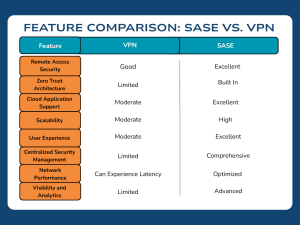
SASE vs. VPN: Key Differences
1. Security Approach
VPN
VPNs operate on a trust-based model. Once users authenticate, they often receive broad access to portions of the corporate network.
SASE
SASE follows Zero Trust principles. Every connection is continuously verified, and users receive access only to authorized applications and resources.
Winner: SASE
2. Performance
VPN
Remote traffic is often routed through a central location before reaching cloud applications. This process, known as backhauling, can create latency and reduce performance.
SASE
Users connect directly to the nearest cloud security point of presence, reducing latency and improving application responsiveness.
Winner: SASE
3. Scalability
VPN
As organizations grow, VPN infrastructure often requires additional hardware, licenses, and bandwidth.
SASE
Because SASE is cloud-delivered, organizations can scale users and locations more easily without significant infrastructure investments.
Winner: SASE
4. User Experience
VPN
Users frequently need to launch VPN clients, select servers, and troubleshoot connectivity issues.
SASE
Access is often more streamlined, with security policies applied transparently in the background.
Winner: SASE
5. Cloud Readiness
VPN
VPNs were designed for on-premises environments and may not be optimized for cloud-first organizations.
SASE
SASE was specifically built to support modern cloud applications, distributed workforces, and branch offices.
Winner: SASE
When a VPN Still Makes Sense

Despite the advantages of SASE, VPNs remain useful in certain situations:
- Small organizations with limited remote users
- Businesses primarily relying on on-premises applications
- Temporary remote access requirements
- Organizations with minimal cloud adoption
For some companies, VPNs can continue to meet security and connectivity needs while maintaining lower upfront costs.
When SASE Is the Better Choice

SASE is often the preferred solution for organizations that:
- Support hybrid or fully remote workforces
- Use cloud applications extensively
- Need stronger security controls and Zero Trust access
- Require consistent user experiences across multiple locations
- Want simplified management through a unified platform
Businesses undergoing digital transformation often find that SASE aligns better with modern networking and cybersecurity requirements.
The Future of Secure Remote Access
The shift toward cloud computing and distributed workforces has exposed many of the limitations of traditional VPN architectures. While VPNs still serve an important role for some organizations, SASE offers a more comprehensive approach by integrating networking and security into a single cloud-based framework.
For organizations seeking stronger security, better performance, and greater scalability, SASE represents a significant evolution in how remote access is delivered and managed.
Conclusion

VPNs and SASE both provide secure access to business resources, but they are designed for different eras of IT. VPNs focus on connecting users to networks, while SASE focuses on securely connecting users directly to applications and data.
As companies continue to adopt cloud services and support remote employees, SASE offers a more flexible, scalable, and security-focused approach. If you’re evaluating secure remote access solutions for your business, the team at Absolute Technology Solutions can help assess your environment and determine whether a traditional VPN, SASE architecture, or a hybrid approach best aligns with your goals.
Works Cited
- Absolute Technology Solutions — IT Services & Web Design. Retrieved August 4, 2026, from Absolute Technology Solutions
- Cisco Systems. “What Is SASE (Secure Access Service Edge)?” Cisco. Retrieved August 4, 2026, from https://www.cisco.com/c/en/us/products/security/what-is-sase.html
- Cloud Security Alliance (CSA). “Secure Access Service Edge (SASE).” Retrieved August 4, 2026, from https://cloudsecurityalliance.org
- Gartner. “The Future of Network Security Is in the Cloud.” Gartner Research. Retrieved August 4, 2026, from https://www.gartner.com
- Microsoft. “Zero Trust Security.” Microsoft Learn. Retrieved August 4, 2026, from https://www.microsoft.com/security/business/zero-trust
- National Institute of Standards and Technology (NIST). “Zero Trust Architecture (SP 800-207).” U.S. Department of Commerce. Retrieved August 4, 2026, from https://csrc.nist.gov/publications/detail/sp/800-207/final
- Palo Alto Networks. “What Is SASE?” Retrieved August 4, 2026, from https://www.paloaltonetworks.com/sase
- VMware. “SASE Explained.” Retrieved August 4, 2026, from https://www.vmware.com/topics/glossary/content/secure-access-service-edge-sase.html
- Zscaler. “VPN vs. Zero Trust Network Access (ZTNA).” Retrieved August 4, 2026, from https://www.zscaler.com/resources/security-terms-glossary/what-is-ztna
Share this Post
What's New?
SASE vs. VPN: Which Is Better for Today’s Remote Workforce?
Why Your Business Needs More Than Antivirus Software

Ransomware Explained: How It Works and How to Stop It

Behind the Scenes: What 24/7 IT Monitoring Really Looks Like